The short answer
Fintech and crypto conferences differ from traditional finance events in a few key ways that matter for production: the audience is online all day, so attendee connectivity is part of the experience; live demos, coding sessions, and hackathons need reliable internet and a fallback plan; the livestream is often a primary deliverable with an online audience far larger than the room; programs change late; and events often run in remote or international venues. Plan connectivity as seriously as the stage, separate production and attendee networks, pre-record demo fallbacks, and build a graphics and playback workflow that can absorb last-minute changes.
A fintech or crypto conference can put a sitting regulator, a sovereign wealth fund, and a room full of protocol developers on the same program. The stakes are those of any finance event: serious speakers, serious money in the room, cameras running. But the audience behaves differently, the content looks different, and the technical demands are heavier than at a traditional investor summit.
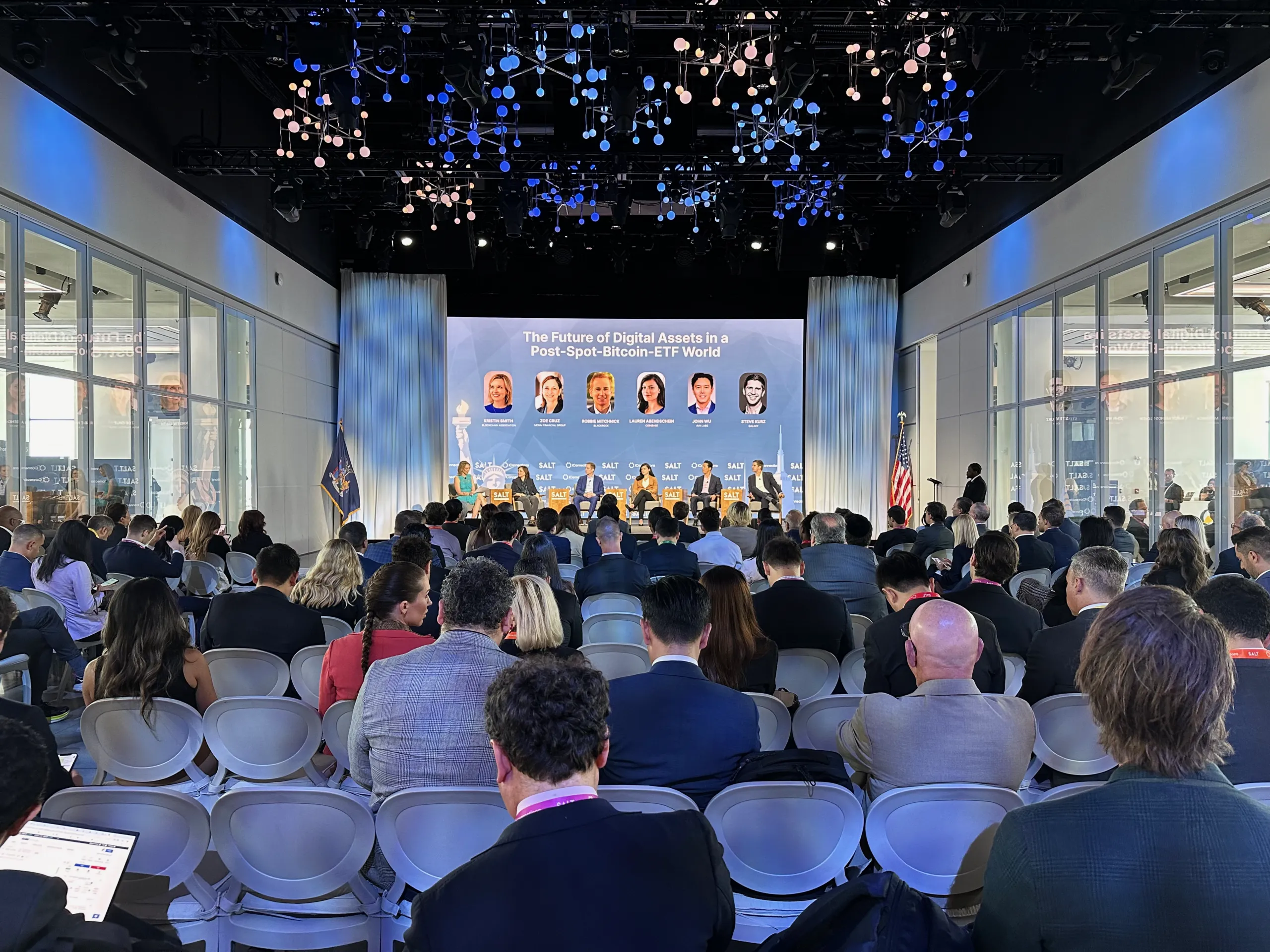
We have produced events across that whole spectrum, from the SALT series to the SALT Wyoming Blockchain Symposium in Jackson Hole and [REDACTED] 2024, the NEAR Foundation's blockchain and AI event in Bangkok. Here is what changes, and how to plan for it.
1. The Audience Is Online All Day
At a traditional finance conference, attendee Wi-Fi is a convenience. At a crypto conference, it is part of the product. Attendees are checking markets, posting, running wallets, and demoing projects to each other in the hallway. When the Wi-Fi fails, the room notices within minutes, and they say so online.
How to plan for it: treat attendee connectivity as its own workstream, sized for the real headcount and the way this audience uses the network. Keep production traffic on a completely separate network so a crowded hallway never touches your stream. At the SALT Wyoming Blockchain Symposium, we built five separate networks with a branded captive portal, supporting production and 100+ simultaneous attendee users.
2. Live Demos, Coding, and Hackathons
Crypto and fintech programs often include things a traditional finance event never would: live product demos, on-chain transactions on stage, live coding, and hackathon presentations. At [REDACTED] 2024, interactive hackathon sessions and live coding demonstrations were a core part of the energy of the event.
Every one of those depends on a laptop, a network connection, and a presenter who has not rehearsed on your system.
How to plan for it:
- Collect demo requirements early: what device, what software, whether it needs the internet, and whether audio comes from the laptop.
- Give demo presenters a hardwired connection on the production network, not attendee Wi-Fi.
- Test every demo on stage during rehearsal, on the presenter's own machine.
- Ask for a pre-recorded version of any demo that has to work, and have it cued as a fallback.
- Plan a clean switch path so the show caller can move between the presenter's screen, slides, and cameras without dead air.
3. The Stream Is a Primary Deliverable
Traditional finance events often stream to a private, credentialed audience of LPs. Crypto events usually stream publicly, and the online audience can be many times the size of the room. At [REDACTED] 2024, more than 30,000 people watched the livestream, against 1,500+ attendees in person.
How to plan for it: design the production for the stream first. That means multi-camera coverage, a dedicated stream audio mix, lower thirds on every speaker, redundant internet with automatic failover, and a backup encoder. It also means planning post-event clips from day one, because this audience shares short moments far more than full sessions. Our livestreaming guide covers the technical setup in detail.
Field note
At [REDACTED] 2024, the main stage had three LED walls wrapped in custom scenic fabric, with a second, smaller stage built to match. The brief was to capture the raw, tech-driven energy of a hacker conference while keeping the polish of a major production. We had 36 hours to build both stages from an empty venue, rehearse, and go live.
4. The Program Changes Late
Crypto moves fast, and so do its conference programs. Speakers get added days before the event. Panels get reshuffled around market news. Slides arrive the morning of the session.
How to plan for it:
- Build lower thirds and title slides from templates so a new speaker takes minutes, not hours.
- Keep the run of show in a live, shared system. We use ShowCall so every department sees changes the moment they are made.
- Staff a dedicated playback operator who owns incoming slides, and set a clear cutoff with a known exception process.
- Keep a stage manager focused on speakers, because the person absorbing late changes cannot also be walking talent to the stage.
5. Remote and International Venues
Crypto and fintech events go where the community is, which is often far from a convention center. Jackson Hole, island jurisdictions, and international hubs all come with limited local infrastructure, fewer local vendors, and venue internet that is either unavailable or absurdly priced.
How to plan for it:
- Price the internet early. Venue quotes for dedicated bandwidth in remote locations can make the math unworkable. At Wyoming, our custom Starlink network came in at roughly 50% of the venue's price.
- Plan for fewer local vendors. In places like Bermuda, where there are no large-scale local AV vendors, equipment has to be sourced and shipped in advance.
- Account for time zones and language. For Bangkok, we worked across a 12-hour time difference with overlapping working hours and bilingual crew on-site.
6. Regulators and Institutions on the Same Stage
As digital assets have moved into the mainstream, fintech and crypto programs increasingly feature regulators, senators, and institutional investors alongside founders. That brings the requirements of a traditional finance event back into the room: security details, strict timing, careful stage management, and a polished broadcast. Production has to serve both audiences at once. Our guide to stage management for VIP speakers covers that side.
The bottom line
A fintech or crypto conference is a finance event with a heavier technical load and a much bigger online audience. Plan connectivity as carefully as the stage, design for the stream, rehearse every demo with a fallback, and build a workflow that expects the program to change.
Frequently Asked Questions
How is producing a crypto conference different from a traditional finance conference?
Crypto conferences put heavy demand on attendee connectivity, include live demos, coding, and hackathons that depend on the internet, usually stream publicly to online audiences much larger than the room, change their programs late, and often run in remote or international venues. The stakes and speaker profile are similar to a finance event, but the technical load is heavier.
How much Wi-Fi does a crypto conference need?
More than a traditional finance event of the same size, because attendees are online constantly. Size attendee Wi-Fi for the actual headcount, keep it on a separate network from production, and never run the livestream or stage demos over attendee Wi-Fi.
How do you run live demos at a conference without them failing?
Collect each demo's requirements early, give presenters a hardwired connection on the production network, test every demo on stage during rehearsal on the presenter's own machine, and have a pre-recorded version cued as a fallback for any demo that has to work.
Should a crypto conference livestream be public?
Often, yes. Crypto audiences are global and online, and public streams can reach audiences many times the size of the room. At [REDACTED] 2024, more than 30,000 people watched the livestream against 1,500+ attendees in person. Some sessions may still be private or off the record, and those should be flagged in the run of show.
What if the venue cannot provide enough internet for a crypto event?
Build your own network. Options include bonded cellular and satellite internet such as Starlink. At the SALT Wyoming Blockchain Symposium, a custom Starlink network supported production and 100+ simultaneous attendee users at roughly 50% of the venue's quoted price.
How do you handle last-minute speaker changes at a fintech conference?
Build lower thirds and title slides from templates, keep the run of show in a live shared system so every department sees changes immediately, assign a dedicated playback operator to own incoming slides, and keep a stage manager focused only on speakers.